Artist: Yuri Elperin
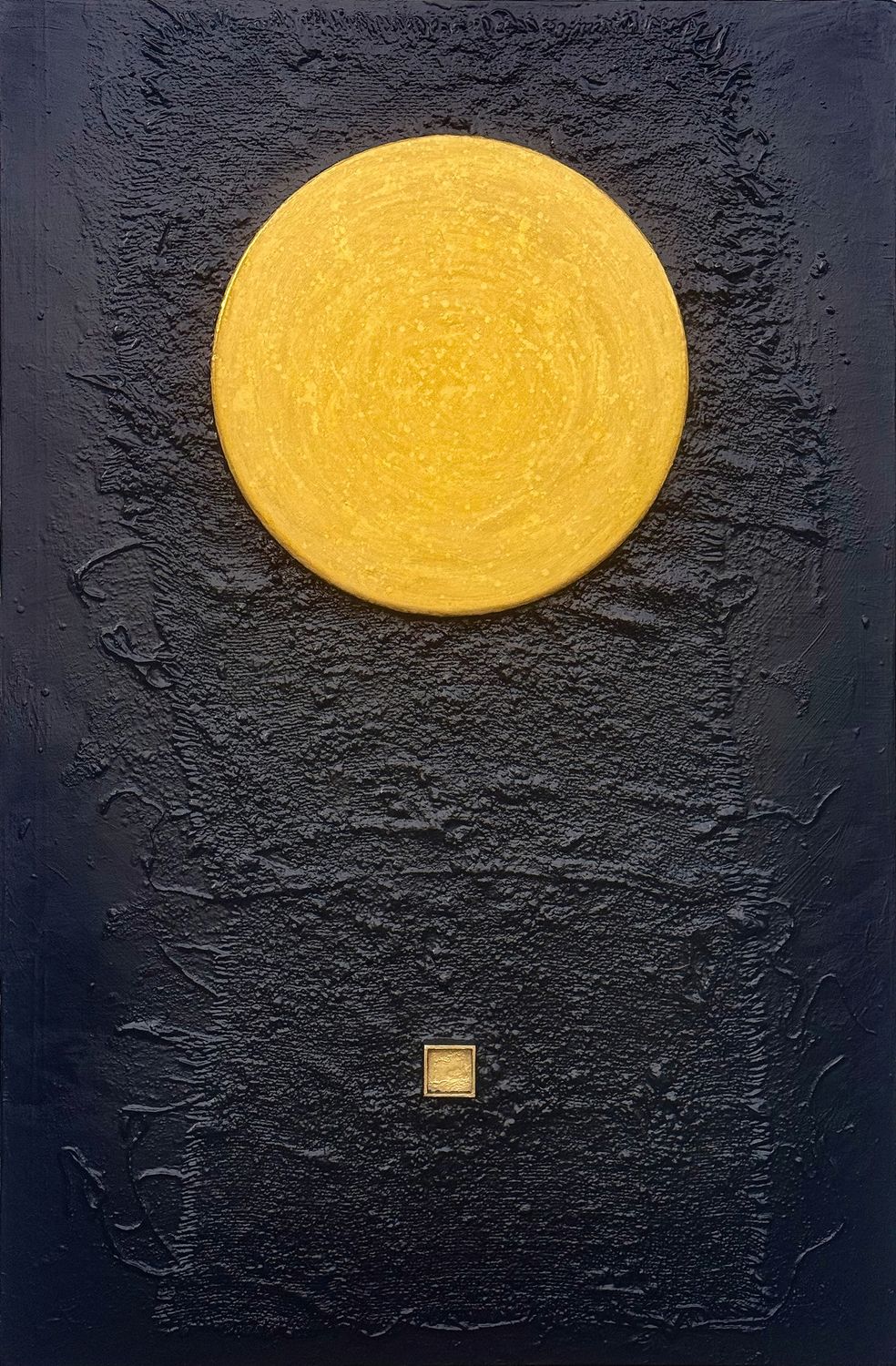
Material World
物质世界
sculpture/painting
60 x 40 x 5inches
2024
In Buddhism, the material world is seen as impermanent, full of sensory experiences, and attachments that can cause suffering, and ultimately not the ultimate reality. In contrast to other religions that may see the material world as a creation of a divine being, Buddhism views it as a constantly changing phenomenon arising from the interaction of causes and conditions, with spiritual liberation found by transcending attachment to it. The material world is the subject of the senses, but is not the ultimate reality, which is in the mind’s awareness of the sensations, which is impermanent.
In Chinese Buddhism, the circle represents the spiritual or celestial realm (heaven), while the square symbolizes the physical, earthly realm. This symbolism is famously represented in the mandala (a symbolic diagram representing the universe), which often features a square within a circle, signifying the union of heaven and earth or the sacred meeting place where spiritual enlightenment is achieved. This concept extends to architectural designs, including the construction of temples, where the two shapes are used to create sacred spaces that connect the human world with the divine.
In Chinese Buddhism, particularly in the Chan (Zen) tradition, the circle is a deeply significant symbol representing enlightenment, emptiness, unity, and the universe.
在佛教中,物质世界被视为无常的,充满感官体验和各种执着,这些都会带来痛苦,但最终并非终极实在。与其他一些宗教将物质世界视为神灵创造的产物不同,佛教认为物质世界是因缘相互作用而产生的不断变化的现象,超越对物质世界的执着即可获得精神解脱。在中国佛教中,圆形代表精神或天界(天),而方形则象征物质的、尘世的领域。这种象征意义在曼荼罗(一种代表宇宙的象征性图表)中得到了著名的体现,曼荼罗通常以圆形内嵌方形,象征着天地合一或证悟成佛的神圣场所。这一概念也延伸到建筑设计中,例如寺庙的建造,在寺庙中,圆形和方形被用来创造连接人间与神界的圣地。在中国佛教,特别是禅宗传统中,圆圈是一个意义深远的象征,代表着觉悟、空性、统一和宇宙。