Artist: Yuri Elperin
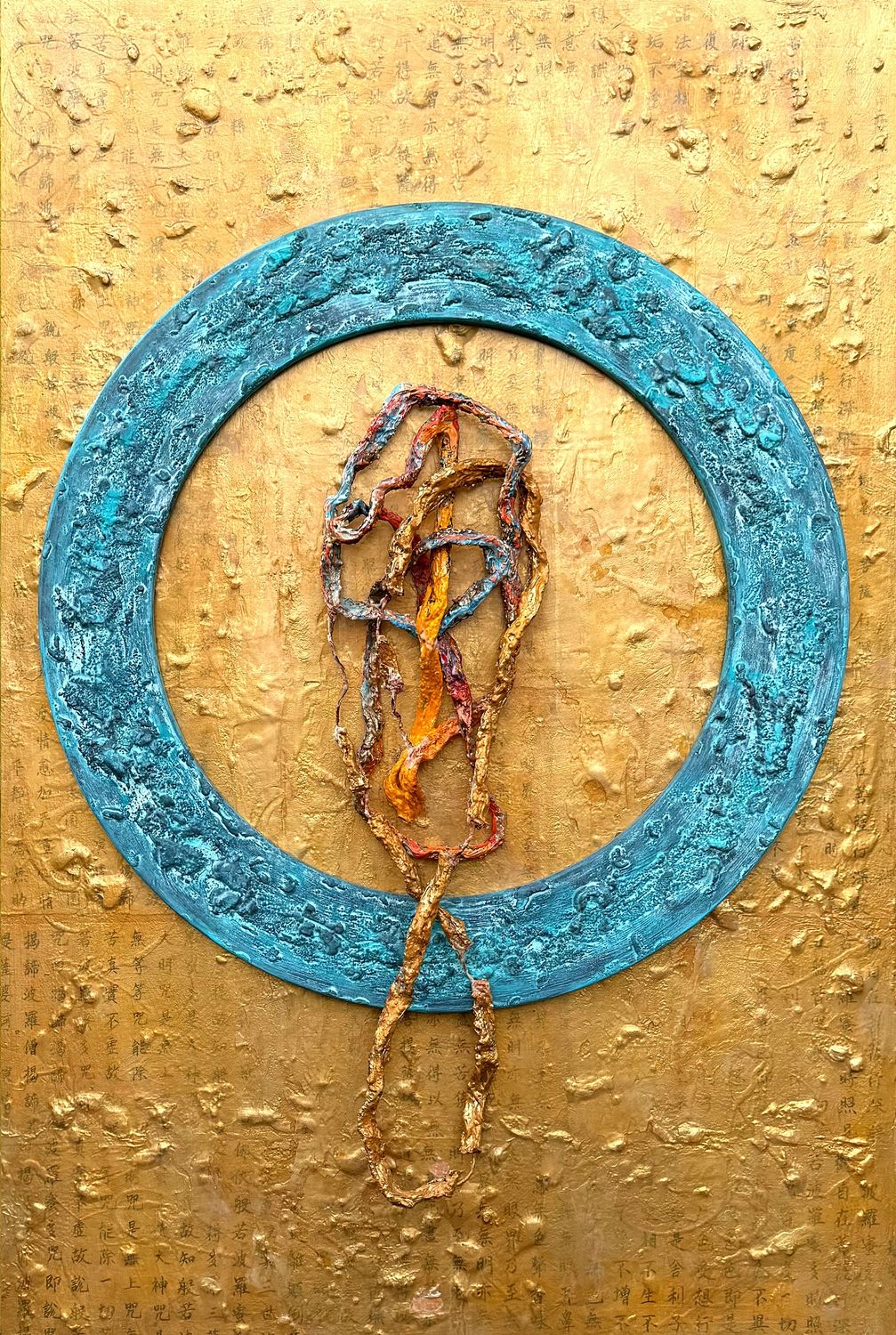
Elements of Infinity
无限元素
Medium: sculpture/mixed media
23 carat gold leaf, oil, acrylic, wood, sand, rice paper with calligraphy by Li Ning, roots, marine plants on canvas and mount on wood panel.
60 x 40 x 6 inches
2024
In Chinese Buddhism, the concept of "infinity" is primarily represented through the symbol of the Endless Knot, and philosophical concepts such as emptiness, and the nature of the Buddha's qualities.
In Chinese Buddhism, the circle represents the spiritual or celestial realm (heaven), while the square symbolizes the physical, earthly realm. This symbolism is famously represented in the mandala (a symbolic diagram representing the universe), which often features a square within a circle, signifying the union of heaven and earth or the sacred meeting place where spiritual enlightenment is achieved. This concept extends to architectural designs, including the construction of temples, where the two shapes are used to create sacred spaces that connect the human world with the divine.
In Chinese Buddhism, particularly in the Chan (Zen) tradition, the circle is a deeply significant symbol representing enlightenment, emptiness, unity, and the universe.
在中国佛教中,“无限”的概念主要通过无尽结的象征意义来体现,并体现在诸如空性、佛性等哲学概念中。在中国佛教中,圆形代表精神或天界(天),而正方形则象征物质、尘世。这种象征意义在曼荼罗(一种代表宇宙的象征性图表)中得到了充分体现,曼荼罗通常包含一个圆内嵌正方形,象征着天地合一,或称证悟的圣地。这一概念也延伸至建筑设计,例如寺庙的建造,在寺庙中,圆形和正方形被用来创造连接人间与神界的圣地。
在中国佛教中,尤其是在禅宗传统中,圆形是一个意义深远的象征,代表着觉悟、空性、统一和宇宙。